


Working Visa vs. Student Visa in Japan: Key Differences Explained
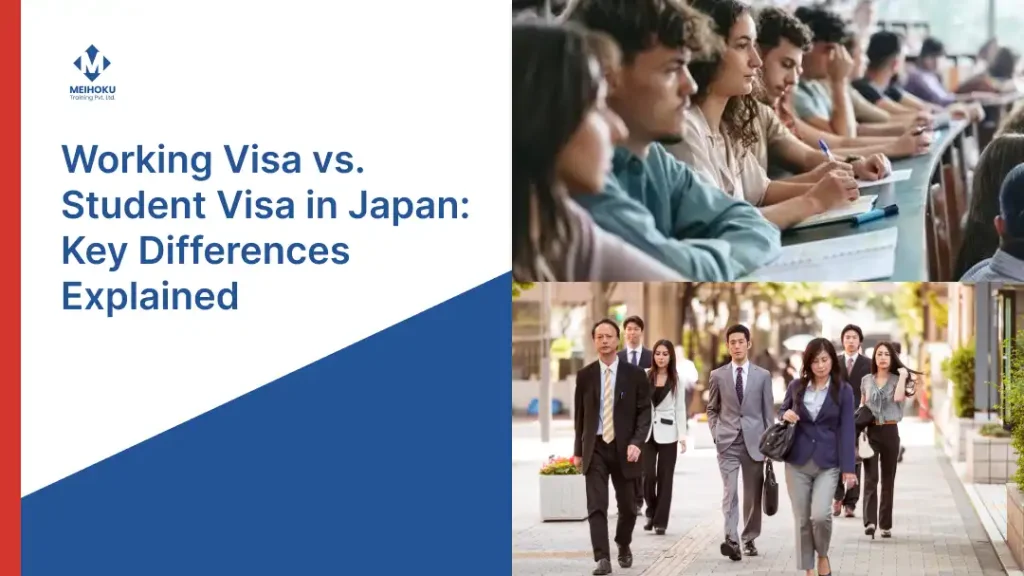
Should you go to Japan on a student visa first, or try to get a work visa directly? This is one of the biggest decisions for Nepali applicants planning to study, work and build a career in Japan.
A student visa can be a practical option for those who need to improve their Japanese language skills, get quality education, gain professional qualifications, or do not yet meet the requirements for professional employment. A work visa, however, allows you to begin full-time employment, if you already have the required skills, qualifications, and a job offer from a Japanese employer.
Before choosing either pathway, it is important to understand how these visas differ in terms of eligibility requirements, costs, work permissions, income opportunities, visa duration, and long-term career prospects.
This guide explains everything you need to know about the working visa in Japan and the student visa so you can make an informed decision based on your career goals, financial situation, and long-term plans.
Working Visa in Japan
A Japan work visa (“Shuro” in Japanese ) is issued to foreign nationals who have secured employment with a Japanese company or organization. The primary purpose of this visa is professional full-time employment.
There are different categories of work visas depending on the type of job, including positions in engineering, IT, education, healthcare, business management, hospitality, and other skilled occupations. The appropriate visa category depends on the applicant’s qualifications and the nature of the job.

Eligibility for a Japan Work Visa
For Nepali applicants looking for a working visa in Japan, the first step is obtaining a job offer from an employer willing to sponsor the visa application. Applicants usually need:
- A valid passport
- A confirmed job offer from a Japanese employer
- Certificate of Eligibility (COE)
- Relevant educational qualifications or professional experience
- Completed visa application form
- Passport-sized photographs
- Employment contract and supporting company documents
Certain professions may require specialized qualifications or licenses depending on Japanese regulations.
Different Types of Japan Work Visa
Main working visa category | General purpose | Examples of eligible work |
Engineer / Specialist in Humanities / International Services | Professional and knowledge-based jobs | IT engineers, software developers, engineers, translators, designers, marketing, business roles |
Highly Skilled Professional | Advanced professionals recognized through a points-based system | Researchers, engineers, business managers, highly qualified specialists |
Specified Skilled Worker (SSW) | Workers in designated labor-shortage industries | Manufacturing, construction, agriculture, food service, hospitality, caregiving, etc. |
Technical Intern Training (TITP) | A separate status for workplace-based skills training | Manufacturing, agriculture, construction, and other technical fields |
Skilled Labor | Specialized practical skills requiring experience | Foreign chefs, craftsmen, sports trainers, specialized technicians |
Business Manager | Operating or managing a business in Japan | Company owners, executives, business operators |
Intra-company Transferee | Transfer of employees within an international company | Overseas employees transferred to a Japanese branch |
Academic / Specialized Professional Activities | Specialized fields with separate immigration categories | University professors, researchers, teachers, medical professionals, legal professionals, artists, journalists |

Student Visa in Japan
A Japan student visa (“Ryugaku” in Japanese) is designed for international students who plan to pursue education in Japan. They can get admission in approved educational institutions including Japanese language schools, vocational colleges, universities, and graduate schools. Although students are also allowed to work part-time, the main objective of this visa is to study.
Japan is an attractive study destination for international students, because of its high-quality education system, modern technology, and safe living environment. For many Nepali students, studying in Japan provides an opportunity to get quality education while earning money through part-time jobs.
Japan Student Visa Requirements for Nepali Applicants
To apply for a Japan student visa, applicants must meet the eligibility criteria set by their educational institution and the Japanese immigration authorities. Although requirements may vary depending on the institution and individual circumstances, applicants generally need:
- A valid passport
- An admission letter from a recognized Japanese educational institution
- Basic Japanese language proficiency (typically JLPT N5 level, where required by the institution)
- A Certificate of Eligibility (COE)
- A completed visa application form
- Recent passport-sized photographs
- Academic certificates and transcripts
- Proof of financial ability to cover tuition fees and living expenses (often demonstrated through a bank balance of around NPR 15–20 lakhs (may vary))
- Any additional supporting documents requested by the Japanese Embassy
Note: Meeting the Japan student visa requirements does not automatically guarantee visa approval. Applicants should ensure that all submitted documents are accurate, complete, and genuine.
Can Students Work in Japan?
A student visa in Japan provides the opportunity to earn extra income through part-time employment. However, students are not permitted to work immediately upon arrival. They must first obtain Permission to Engage in Activity Other Than That Permitted (Shikakugai Katsudō Kyoka) from the Japanese immigration authorities.
Once approved, students can generally work up to 28 hours per week during academic sessions and longer hours during designated school holidays, following Japanese immigration regulations.
While part-time work can help with living expenses, students should remember that their primary purpose in Japan is to complete their education.
Key Differences to Consider
Choosing between a Japan student visa and a Japan work visa depends on your personal goals, financial situation, and long-term career plans. Understanding their differences can help you decide which option is the right fit for your future.
Feature | Japan Student Visa | Japan Work Visa |
Primary Purpose | Study at an educational institution | Full-time employment |
Sponsor | Educational institution | Japanese employer |
Work Permission | Part-time with approval | Full-time employment |
Income | Limited part-time earnings | Regular full-time salary |
Visa Duration | Based on study program | Based on employment contract |
Dependents | Possible under certain conditions | Usually easier if eligibility requirements are met |
Career Path | Can switch to work visa after graduation | Direct career growth in Japan |
Permanent Residency | Indirect pathway | More direct pathway with continued employment |
1. Primary Purpose
A Japan student visa is issued to individuals whose main objective is education. Whether you plan to attend a language school, vocational college, or university, your primary responsibility is to complete your studies successfully.
A Japan work visa, on the other hand, is meant for people who have already secured employment in Japan. Instead of attending classes, visa holders work full-time for their sponsoring employer and contribute to Japan’s workforce.
Note: If you already meet the qualifications for employment and want to begin working immediately, a work visa may be more suitable.
2. Eligibility Requirements
For a Japan student visa, applicants must first receive admission from a recognized educational institution. They must also demonstrate that they have enough financial resources to pay tuition fees and living expenses during their stay.
For a Japan work visa, applicants generally need a confirmed job offer from a Japanese employer. Depending on the job category, employers may also expect applicants to have relevant educational qualifications, Japanese language proficiency, professional experience, or technical skills.
3. Who Sponsors Your Visa
For a Japan student visa, your educational institution acts as the sponsoring organization where you have been admitted. The school helps process the required documents, including the Certificate of Eligibility (COE).
In terms of working visa, your employer in Japan is your sponsor, who’ll be responsible for the COE application and ensuring your employment meets immigration criteria.
4. Work Rights and Restrictions
Student visa holders can work part-time typically 28 hours per week during term time and up to 40 hours during academic breaks after receiving permission from the immigration authorities.
A Japan work visa allows holders to work full-time according to the conditions stated in their employment contract. Since employment is the main purpose of the visa, there are no general hourly restrictions like those placed on students.
5. Income Potential
Students usually earn money through part-time jobs due to hourly restrictions. While this income can help cover rent, food, transportation, and daily living expenses, it is generally not enough to replace a full-time salary. Students also need to balance work with their academic responsibilities.
In contrast, people on a working visa receive a basic salary in Japan based on their profession, experience, and employer. Many companies also provide additional benefits such as overtime pay, bonuses, health insurance, transportation allowances, and paid leave.
If your main priority is financial stability, a working visa generally offers greater earning potential than a student visa.
6. Visa Duration and Renewal
A Japan student visa is usually issued for the duration of your academic program like 6 months, 1 year, or 2 years. If you continue your education or enroll in another eligible course, you may apply to extend your period of stay.
A Japan work visa is granted based on your employment status and visa category. As long as you continue meeting the visa requirements and remain employed in an eligible position, you can usually renew your visa before it expires.
7. Bringing Dependents
Student visa holders may be able to bring eligible dependents under certain conditions, but they generally need to show that they have enough financial resources to support them while studying.
It’s generally easier for work visa holders to sponsor dependents. You may also apply for dependent visas for eligible family members. Since they typically have a stable full-time income, meeting the financial requirements is often more manageable.
8. Long-Term Residency and Career Opportunities
While time spent on a student visa can contribute to the overall residency period for Permanent Residency (PR), it does not directly count towards the work-visa years required for PR. It serves as a foundation for future career opportunities after transitioning to a working visa.
A Japan work visa offers a more direct path toward professional growth. By gaining work experience, paying taxes, and maintaining legal residency, visa holders may eventually become eligible for longer-term residence options if they meet Japan’s immigration requirements. For SSW visa holders, transitioning from SSW-1 to SSW-2 can also open doors to family sponsorship and PR eligibility.
Can You Switch from a Student Visa to a Working Visa?
Yes, switching from a student visa to a working visa is very common among international students in Japan. Many students, including Nepali students, begin their journey with a Japan student visa and later transition to a Japan work visa after graduation.
To make this change, you must first secure a job with a Japanese employer that qualifies for a work visa. The position should match your educational background or professional skills and meet the requirements set by Japanese immigration authorities.
After receiving a job offer, you can apply to change your residence status while you are in Japan. If your application is approved, you can begin working full-time under your new visa status.
Which Option Is Better for You?
A Japan student visa may be the better option if you:
- Want to earn a degree or professional qualification in Japan.
- Need time to improve your Japanese language skills.
- Plan to build your career after completing your education.
- Are comfortable managing study and part-time work together.
A Japan work visa may be more suitable if you:
- Already have the required qualifications or work experience.
- Have secured a job offer from a Japanese employer.
- Want to start earning a full-time salary immediately.
- Aim to build a long-term career in Japan.
Conclusion
Both the student and work visa in Japan provide valuable opportunities for international applicants. Choosing between these pathways, solely depends on your current qualifications, goals, and future plans.
For Nepali applicants, the right choice depends on where you are in your academic and professional journey. If you want to invest in your education and improve your future job prospects, studying in Japan can open many doors. If you already meet the qualifications for employment and have a job offer, applying for a working visa can help you start your career sooner.
Frequently Asked Questions
1. Is a work visa better than a student visa?
A work visa is not always better than a student visa; the better option depends on your current situation, qualifications, and career goals. A Japan work visa may be the better choice if you already have the required education, skills, and professional experience, to work full-time. A Japan student visa may be more suitable if you want to gain academic qualifications, improve your Japanese language ability, or do not yet meet the requirements for professional employment.
2. Can I convert my student visa to a work permit?
Yes, you can change from a student visa to a work visa if you qualify for a work visa category and meet the requirements set by Japanese immigration authorities. Many international students graduate from Japanese language schools, vocational colleges, or universities and then transition to employment.
3. Can I convert my work visa to a student visa?
Yes, it is possible to change from a Japan work visa to a student visa if you decide to pursue further education in Japan. But, your ability to work will also be limited to the part-time work rules set for student visa holders.
4. Is a work visa the same as a student visa?
No, a work visa and a student visa are different types of residence statuses in Japan. A student visa (Ryugaku) is for studying at approved educational institutions such as language schools, universities, vocational colleges, or graduate schools. A work visa (Shuro) is for full-time employment with a Japanese employer in an eligible occupation.
5. What are the benefits of a work visa?
A Japan work visa provides several benefits for foreign professionals who meet the eligibility requirements, including:
- Full-time employment
- Stable income
- Career growth opportunities
- Employee benefits
- Family sponsorship opportunities
- Long-term career pathway and residency options
Start Your Journey Today
Admission for the 2025 intake is now open. Seats are limited. Contact us to schedule a free counseling session.
MEIHOKU TRAINING PVT. LTD.

Call Us
+977 9802325688, 01-4031688

Email Us
meihokunepal@gmail.com

Our Location
Sukedhara-04, Akhanda Marg, Kathmandu, Nepal