


150+ Basic Japanese Words Every Beginner Must Know
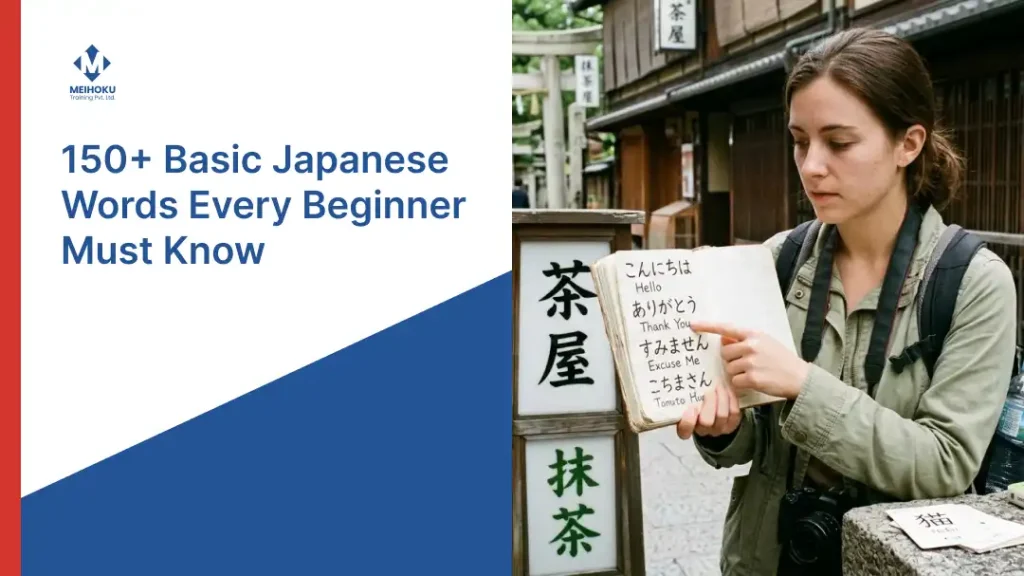
Whether you are studying, working, traveling or living in Japan for some time, learning some simple Japanese words would make your day-to-day communication much easier. Be it greeting someone properly or ordering food, if you know the right words then your confidence in real life situations is utilized to the fullest.
In this guide, you will learn the 150+ basic Japanese words every beginner must all know. Each word is presented with its Japanese script, Romaji pronunciation, and English meaning, making it easier to read, pronounce and memorize. Whether you’re just starting your Japanese language journey or preparing for the language exam, these commonly used words will help you build a strong foundation in Japanese Language.
Why Learning Basic Japanese Words Is Important
Learning basic Japanese words is the first step to becoming competent and confident in the Japanese language. A sufficient understanding of Japanese words helps you to communicate more easily on an everyday basis and it also serves as a good base for learning Japanese Language.
Knowing common Japanese words can help you:
- Communicate with confidence in everyday situations.
- Greet people and introduce yourself politely.
- Ask and answer everyday questions.
- Ordering food, asking for directions and navigating around Japan.
- Studying for the JLPT N5 exam and building a good base for the rest.
- Improve your speaking, listening, reading and overall communication skills.
NOTE: If you are starting from scratch and want to read what JLPT is, then check our guide on What is JLPT? for a full overview.
Common Japanese Words and Phrases for Everyday Conversation
Learning a few common Japanese words and phrases can help you handle everyday conversations with confidence. These are expressions you’ll hear and use frequently when introducing yourself, asking simple questions, or responding to others.
Common Japanese Words
Japanese | Pronunciation (Romaji) | Meaning |
はい | Hai | Yes |
いいえ | Iie | No |
もちろん | Mochiron | Of course |
たぶん | Tabun | Maybe |
わかります | Wakarimasu | I understand |
わかりません | Wakarimasen | I don’t understand |
だいじょうぶ | Daijōbu | It’s okay / I’m fine |
ほんとう | Hontō | Really / True |
もういちど | Mō ichido | One more time |
ゆっくり | Yukkuri | Slowly |
Common Japanese Phrases
Japanese | Pronunciation (Romaji) | Meaning |
おなまえはなんですか? | Onamae wa nan desu ka? | What is your name? |
わたしのなまえは〜です。 | Watashi no namae wa [Tarō] desu. | My name is Taro. |
おげんきですか? | Ogenki desu ka? | How are you? |
はい、げんきです。 | Hai, genki desu. | Yes, I’m fine. |
どこからきましたか? | Doko kara kimashita ka? | Where are you from? |
ネパールからきました。 | Nepāru kara kimashita. | I am from Nepal. |
にほんごをべんきょうしています。 | Nihongo o benkyō shiteimasu. | I am learning Japanese. |
てつだってください。 | Tetsudatte kudasai. | Please help me. |
もういちどおねがいします。 | Mō ichido onegaishimasu. | Please say that again. |
よろしくおねがいします。 | Yoroshiku onegaishimasu. | Nice to meet you / I look forward to your support. |
Common Japanese Greeting Words
Greetings are an important part of Japanese culture and are used in almost every conversation. Learning these common Japanese greeting words will help you make a good first impression and communicate politely in everyday situations.
Japanese | Pronunciation (Romaji) | Meaning |
おはようございます | Ohayō gozaimasu | Good morning |
こんにちは | Konnichiwa | Hello |
こんばんは | Konbanwa | Good evening |
おやすみなさい | Oyasuminasai | Good night |
さようなら | Sayōnara | Goodbye |
ありがとうございます | Arigatō gozaimasu | Thank you |
どういたしまして | Dōitashimashite | You’re welcome |
すみません | Sumimasen | Excuse me / Sorry |
ごめんなさい | Gomennasai | I’m sorry |
はじめまして | Hajimemashite | Nice to meet you |
Basic Japanese Words for Numbers
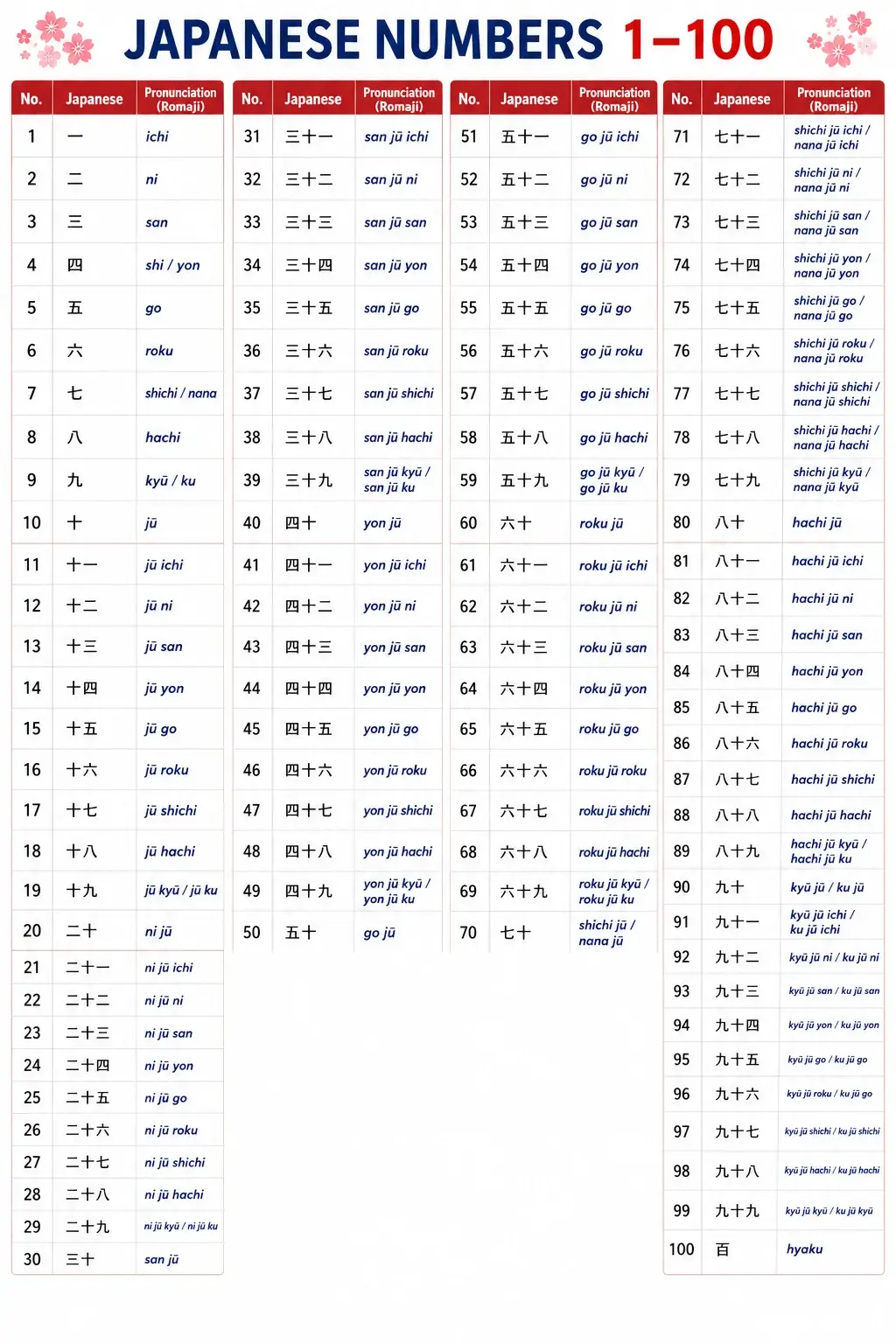
Numbers are among the first things every Japanese learner should know. For instance, besides the case of a simple time-telling, you will often need the knowledge of Japanese numbers when going shopping or asking for the price of something, giving a phone number, etc. The chart below covers the numbers from 1 to 100, along with their Japanese writing and pronunciation (Romaji).
How Japanese Numbers Work
- 1–10 have unique words that you need to memorize.
Example:
- 3 = San (三)
- 5 = Go (五)
- 10 = Jū (十)
- 11–19 are formed by combining 10 (Jū) with the numbers 1–9.
Example:
- 11 = Jū ichi (十一) ⇒ Ten + One
- 15 = Jū go (十五) ⇒ Ten + Five
- 19 = Jū kyū (十九) ⇒ Ten + Nine
- 20, 30, 40… 90 are formed by combining the number with Jū (10).
Example:
- 20 = Ni jū (二十) ⇒ Two × Ten
- 50 = Go jū (五十) ⇒ Five × Ten
- 80 = Hachi jū (八十) ⇒ Eight × Ten
- 21–99 are formed by combining the tens with the ones.
Example:
- 24 = Ni jū yon (二十四) ⇒ Twenty-Four
- 47 = Yon jū nana (四十七) ⇒ Forty-Seven
- 89 = Hachi jū kyū (八十九) ⇒ Eighty-Nine
- 100 is written as Hyaku (百).
Japanese Words for Family and People
Whether you’re introducing your family, talking about friends, or meeting new people, these are some of the most common Japanese words you’ll use in everyday conversations.
Japanese | Pronunciation (Romaji) | Meaning |
家族 | Kazoku | Family |
父 | Chichi | Father |
母 | Haha | Mother |
兄 | Ani | Older Brother |
姉 | Ane | Older Sister |
弟 | Otōto | Younger Brother |
妹 | Imōto | Younger Sister |
友達 | Tomodachi | Friend |
先生 | Sensei | Teacher |
学生 | Gakusei | Student |
男 | Otoko | Man |
女 | Onna | Woman |
Japanese Words for Food and Drinks
Knowing the names of common foods and drinks can make ordering at restaurants, shopping, or talking about your favorite meals much easier. Here are some basic Japanese words you’ll hear and use in everyday life.
Japanese | Pronunciation (Romaji) | Meaning |
食べ物 | Tabemono | Food |
飲み物 | Nomimono | Drink / Beverage |
水 | Mizu | Water |
お茶 | Ocha | Tea |
コーヒー | Kōhī | Coffee |
ご飯 | Gohan | Cooked Rice / Meal |
パン | Pan | Bread |
肉 | Niku | Meat |
魚 | Sakana | Fish |
野菜 | Yasai | Vegetables |
果物 | Kudamono | Fruits |
卵 | Tamago | Egg |
Basic Japanese Words for Time
Time-related words are used every day, whether you’re checking the time, talking about your schedule, or making plans. Below, you’ll find common Japanese words related to time, days, months, and seasons to help you understand dates, schedules, and everyday conversations more easily.
Time
Japanese | Pronunciation (Romaji) | Meaning |
時間 | Jikan | Time |
時 | Ji | O’clock / Hour |
分 | Fun / Pun | Minute |
秒 | Byō | Second |
今日 | Kyō | Today |
明日 | Ashita | Tomorrow |
昨日 | Kinō | Yesterday |
今 | Ima | Now |
朝 | Asa | Morning |
昼 | Hiru | Afternoon / Noon |
夕方 | Yūgata | Evening |
夜 | Yoru | Night |
Days
Japanese | Pronunciation (Romaji) | Meaning |
日曜日 | Nichiyōbi | Sunday |
月曜日 | Getsuyōbi | Monday |
火曜日 | Kayōbi | Tuesday |
水曜日 | Suiyōbi | Wednesday |
木曜日 | Mokuyōbi | Thursday |
金曜日 | Kinyōbi | Friday |
土曜日 | Doyōbi | Saturday |
Months
Japanese | Pronunciation (Romaji) | Meaning |
一月 | Ichigatsu | January |
二月 | Nigatsu | February |
三月 | Sangatsu | March |
四月 | Shigatsu | April |
五月 | Gogatsu | May |
六月 | Rokugatsu | June |
七月 | Shichigatsu | July |
八月 | Hachigatsu | August |
九月 | Kugatsu | September |
十月 | Jūgatsu | October |
十一月 | Jūichigatsu | November |
十二月 | Jūnigatsu | December |
Seasons
Japanese | Pronunciation (Romaji) | Meaning |
春 | Haru | Spring |
夏 | Natsu | Summer |
秋 | Aki | Autumn / Fall |
冬 | Fuyu | Winter |
Japanese Words for Places
Whether you’re travelling, studying, or living in Japan, knowing the names of common places can help you ask for directions and communicate more confidently. Here are some essential Japanese words for places you’ll come across in everyday life.
Japanese | Pronunciation (Romaji) | Meaning |
学校 | Gakkō | School |
駅 | Eki | Station |
病院 | Byōin | Hospital |
レストラン | Resutoran | Restaurant |
ホテル | Hoteru | Hotel |
銀行 | Ginkō | Bank |
公園 | Kōen | Park |
空港 | Kūkō | Airport |
店 | Mise | Shop / Store |
家 | Ie | Home / House |
会社 | Kaisha | Company / Office |
トイレ | Toire | Toilet / Restroom |
Basic Japanese Words for Transportation
Transportation-related words are useful when travelling, commuting, or asking for directions in Japan. Learning these basic Japanese words will help you navigate public transport and communicate more confidently during your daily journey.
Japanese | Pronunciation (Romaji) | Meaning |
電車 | Densha | Train |
新幹線 | Shinkansen | Bullet Train |
地下鉄 | Chikatetsu | Subway / Metro |
バス | Basu | Bus |
タクシー | Takushī | Taxi |
飛行機 | Hikōki | Airplane |
車 | Kuruma | Car |
自転車 | Jitensha | Bicycle |
バイク | Baiku | Motorcycle |
船 | Fune | Boat / Ship |
Question Words in Japanese
Question words are essential for everyday conversations. They help you ask for information, directions, time, and other details when communicating in Japanese.
Japanese | Pronunciation (Romaji) | Meaning |
何 | Nani | What |
誰 | Dare | Who |
どこ | Doko | Where |
いつ | Itsu | When |
なぜ | Naze | Why |
どう | Dō | How |
どれ | Dore | Which |
いくら | Ikura | How much |
いくつ | Ikutsu | How many / How old |
どちら | Dochira | Which direction / Which one (polite) |
Colors in Japanese
Learning color names in Japanese is useful for describing objects, shopping, giving directions, and everyday conversations. Here are some of the most common colors every beginner should know.
Japanese | Pronunciation (Romaji) | Meaning |
赤 | Aka | Red |
青 | Ao | Blue |
黄色 | Kiiro | Yellow |
緑 | Midori | Green |
白 | Shiro | White |
黒 | Kuro | Black |
茶色 | Chairo | Brown |
紫 | Murasaki | Purple |
ピンク | Pinku | Pink |
オレンジ | Orenji | Orange |
灰色 | Haiiro | Gray |
金色 | Kin’iro | Gold |
Common Japanese Verbs
Verbs are action words that help you express what you do in everyday life. Learning these common Japanese verbs will make it easier to build simple sentences and have basic conversations.
Japanese | Pronunciation (Romaji) | Meaning |
行く | Iku | To go |
来る | Kuru | To come |
食べる | Taberu | To eat |
飲む | Nomu | To drink |
見る | Miru | To see / To watch |
聞く | Kiku | To listen / To ask |
話す | Hanasu | To speak |
読む | Yomu | To read |
書く | Kaku | To write |
買う | Kau | To buy |
寝る | Neru | To sleep |
勉強する | Benkyō suru | To study |
Common Japanese Adjectives
Adjectives help you describe people, places, and things in everyday conversations. Here are some common Japanese adjectives that every beginner should know.
Japanese | Pronunciation (Romaji) | Meaning |
大きい | Ōkii | Big |
小さい | Chiisai | Small |
新しい | Atarashii | New |
古い | Furui | Old |
良い | Yoi / Ii | Good |
悪い | Warui | Bad |
高い | Takai | Expensive / High |
安い | Yasui | Cheap |
早い | Hayai | Early / Fast |
遅い | Osoi | Late / Slow |
暑い | Atsui | Hot |
寒い | Samui | Cold |
Tips to Remember Basic Japanese Words
Learning vocabulary effectively becomes a whole new experience when you use the words frequently rather than just remembering it. Here are some tips which would help you remember basic Japanese words effectively:
- Practice Daily: Acquaint yourself with 5, 10 words each day, not hundreds in a single session. Daily practice has been proven to be one of the fastest ways to learn Japanese.
- Flashcard Method: Use flashcards, language apps, or similar tools to review words on a regular basis. The technique of repeated review at fixed periods helps to enhance long-term memory.
- Speak Out Loud: Articulate and repeat a word a couple of times in a row. It helps you to remember the pronunciation and also get confident when talking in Japanese.
- Contextual Learning: Rather than memorizing the words by themselves, incorporate them into short sentences. It helps you grasp the way words are being used in natural conversation.
- Media Exposure: Get the hang of basic Japanese vocabulary naturally by watching TV shows or anime or by listening to Japanese songs.
- Regular review: You should go back to the words that you previously had learned a few days later. The regular refresher makes it easier for you to remember new words for an extended period.
- JLPT Preparation: If you are preparing for JLPT, keep a vocabulary review every day. Building a strong vocabulary is one of the tips to pass the JLPT N5 exam, and reviewing common words regularly can also help you avoid some of the common JLPT mistakes before the exam.
Start Learning Japanese with Confidence
Memorizing some basic words of Japanese language will give you confidence to learn it. You will easily understand Japanese language and be able to use it in your daily life if you practice these words frequently. Self-learning is one of the best ways to start, but with good guidance, you can progress faster and build a stronger foundation..
At Meihoku Japanese Language Institute, we believe that learning Japanese should be practical, engaging, and easy to follow. Whether you’re preparing to study, work, or live in Japan, our experienced instructors and modern learning facilities provide a comfortable environment to help you achieve your goals.
Frequently Asked Questions
1. How many Japanese words should a beginner learn first?
A good starting point is to learn 50–100 common Japanese words. These words cover everyday conversations, greetings, numbers, food, places, and other essential topics. Once you’re comfortable with them, you can gradually expand your vocabulary.
2. What is the best way to learn basic Japanese words?
The best way is to learn a few words every day and use them in real-life situations. Practice speaking them aloud, review them regularly with flashcards, and try using them in simple sentences. Watching Japanese TV shows, listening to Japanese songs, and reading beginner-friendly materials can also help reinforce your vocabulary.
3. Can I learn basic Japanese words by myself?
Yes. Many beginners start learning Japanese on their own using books, apps, videos, and online resources. However, joining a structured Japanese language course can help you improve your pronunciation, grammar, and speaking skills more effectively.
4. How long does it take to learn basic Japanese words?
The time depends on your learning pace and how often you practice. If you study consistently for 15–30 minutes a day, you can learn and remember some basic Japanese words within a few weeks.
5. Are basic Japanese words enough for daily conversations?
Basic Japanese words are enough to handle simple conversations, such as greeting people, asking basic questions, ordering food, or asking for directions. However, to communicate more confidently, you’ll also need to learn grammar, sentence patterns, and expand your vocabulary over time.
Start Your Journey Today
Admission for the 2025 intake is now open. Seats are limited. Contact us to schedule a free counseling session.
MEIHOKU TRAINING PVT. LTD.

Call Us
+977 9802325688, 01-4031688

Email Us
meihokunepal@gmail.com

Our Location
Sukedhara-04, Akhanda Marg, Kathmandu, Nepal