


Japanese Culture and Etiquette for Nepali Workers: A Practical Guide
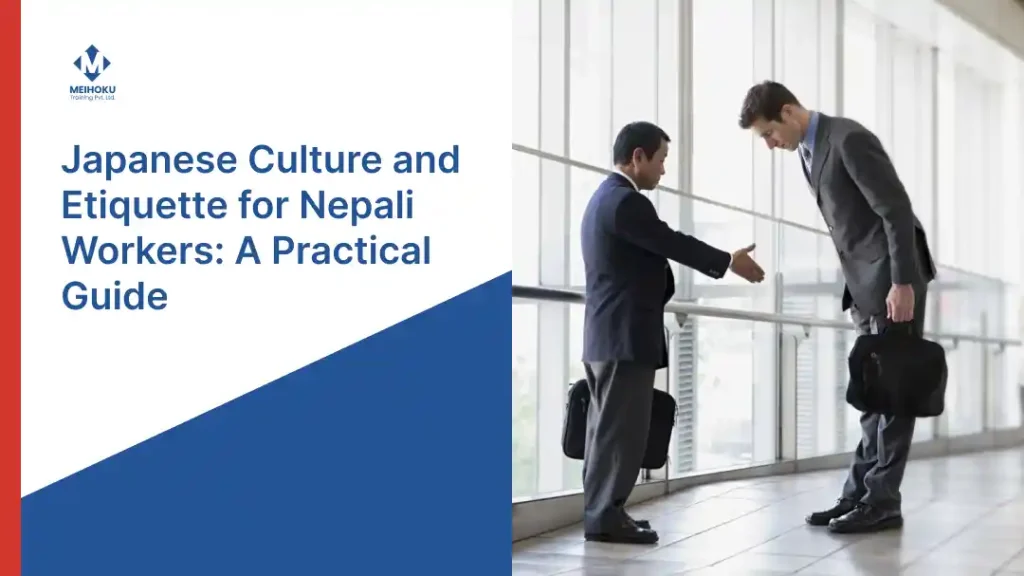
Every year, thousands of Nepali workers pass their JLPT exam, complete visa formalities, and board a flight to Japan believing the hardest part is behind them. Then they arrive, and a different kind of learning curve begins; one that has almost nothing to do with grammar or vocabulary.
For Nepali workers entering the country through the Technical Intern Training Program (TITP) or Specified Skilled Worker (SSW) visa, cultural adjustment often decides whether the first few months feel manageable or overwhelming. By understanding these expectations before you arrive, you can feel more confident, adapt faster, and make a smoother transition to working and living in Japan.
This guide covers the Japanese etiquette and cultural practices that matter most for Nepali workers, from workplace manners and communication styles to dormitory rules and everyday life in Japan.
Why Cultural Adaptation Matters as Much as Language Skill
Passing N5, N4, or N3 proves you can read, write, and speak Japanese. It does not prepare you for the unwritten rules that govern how Japanese workplaces and communities actually function.
Employers in Japan frequently report that new foreign workers rarely struggle with basic Japanese vocabulary in their first few weeks. They struggle with etiquette; not knowing when to bow, misreading an indirect refusal as agreement, or reacting defensively to feedback that was actually intended as routine guidance. These are small missteps individually, but they accumulate, and in a culture where trust is built gradually and through consistent behavior, early impressions carry weight.
Japanese Workplace Etiquette
Japanese workplaces run on a set of manners that are rarely written down but consistently expected. Getting these right early builds credibility fast.
1. Bowing (ojigi)
Japan uses several distinct bow depths, each carrying a different meaning. A light 15-degree nod-bow (eshaku) is standard for everyday greetings between colleagues. A deeper 30-degree bow (keirei) is used when greeting supervisors, clients, or in more formal settings. The deepest bow, around 45 degrees (saikeirei), is reserved for sincere apologies or highly formal occasions. You don’t need to master every variation immediately, a respectful nod-bow at the right moment already signals cultural awareness that most new workers lack.
2. Punctuality
In Japan, “on time” effectively means arriving 5–10 minutes early. Arriving at the exact start time can be read as cutting it close, and repeated lateness, even by a minute or two, is taken far more seriously than in many other work cultures. This applies to shifts, meetings, training sessions, and even casual team gatherings.
3. Hō-Ren-Sō (報連相)
This is one of the most important workplace habits in Japan: Hōkoku (report), Renraku (contact), Sōdan (consult). Workers are expected to proactively report progress, inform supervisors of any changes or problems, and consult before issues escalate, rather than waiting to be asked. In construction and manufacturing roles especially, where safety depends on clear and timely communication, silence about a developing problem is considered far more dangerous than admitting one early.
4. Senpai-kōhai hierarchy
Seniority matters more than job title alone. A newer worker (kōhai) is expected to show deference to someone who joined earlier (senpai), even if the senpai is younger. This affects who you ask for help, how you phrase requests, and how tasks and shifts get assigned. Understanding this hierarchy prevents the common mistake of assuming that job title alone determines who to defer to.
5. Receiving feedback
Corrective feedback in Japan is rarely softened with praise beforehand, a supervisor pointing out a mistake is being direct about the task, not making a personal judgment. The expected response is to acknowledge briefly, adjust the behavior, and follow up privately afterward if clarification is genuinely needed. Visibly explaining your reasoning in the moment, even when you’re factually correct, can come across as pushing back rather than listening.
Communication Norms Nepali Workers Should Know
Japanese communication relies heavily on context and indirectness, which can be the hardest adjustment for newcomers.
1. Indirect refusal
Japanese colleagues rarely say “no” outright, since direct refusal can feel confrontational. Phrases like “it’s a bit difficult” (chotto muzukashii desu) usually mean no. Learning to recognize these signals prevents the common misunderstanding of assuming agreement when none was actually given.
2. Reading the room (kūki wo yomu)
Literally “reading the air,” this describes the skill of sensing unspoken expectations from tone, pauses, and group behavior rather than explicit instructions. Much of what’s expected in a Japanese workplace is communicated this way, especially around group decisions and unstated priorities.
3. Humility over explanation
When a mistake happens, a short, sincere apology (sumimasen, mōshiwake gozaimasen) lands better than a detailed justification, even if the mistake wasn’t entirely your fault.
4. Everyday work phrases
Simple greetings go a long way:
Phrase | Meaning | When to use it |
Ohayou gozaimasu | Good morning | Start of the workday, even in the afternoon shift’s “morning” |
Otsukaresama desu | Thank you for your hard work | Said to colleagues at the end of a shift or task |
Yoroshiku onegaishimasu | Please treat me well / I appreciate your cooperation | Meeting someone new, starting a new task |
Sumimasen | Excuse me / I’m sorry | Minor apologies, getting someone’s attention |
Shitsurei shimasu | Excuse me for the interruption | Entering a room, ending a phone call, leaving before others |
Daily Life and Dormitory Etiquette
Daily life in Japan runs on its own dense set of customs, and several of these catch new arrivals off guard within their first month.
1. Garbage sorting
Japan separates household waste into multiple categories; typically burnable, non-burnable, recyclables (further split into cans, bottles, PET plastics, and paper), and oversized items, each with specific, strictly enforced collection days. Missing a collection day, or sorting incorrectly, is one of the most common early friction points for new residents, and neighbors or landlords often notice quickly.
2. Shoes indoors
Shoes come off at the entrance (genkan) of homes, dormitories, and many workplaces, with indoor slippers typically provided or expected. In some facilities, a separate pair of slippers is used specifically for bathrooms
3. Shared bathing
If your accommodation includes a shared bath (sentō-style), wash and rinse thoroughly before entering the shared tub. The shared tub water is for soaking, not for washing, and this distinction matters culturally even when it isn’t explicitly explained to newcomers.
4. Noise awareness in shared housing
Dormitory living requires attention to noise, especially in the evening and early morning. Quiet hallways and shared spaces are a sign of respect for neighbors, not just a rule to follow.
Industry-Specific Culture Notes
Working with elderly residents calls for a gentler, more formal tone than everyday conversation, along with real patience for slower routines, repeated instructions, and physical assistance tasks. Respectful language toward elderly residents is taken seriously and directly affects how trusted a caregiver becomes.
Hygiene rituals, structured handwashing routines, uniform and hairnet standards, and a consistent greeting to every customer (irasshaimase) are treated as core professionalism rather than extra steps. Guests expect identical posture, tone, and greeting phrases from every staff member, which means personal variation in how you greet customers is minimized by design.
Daily safety briefings (chōrei) are a fixed ritual, often including a group stretch or safety pledge before work begins. The Hō-Ren-Sō habit described earlier is especially critical here, a worker who stays silent about a developing hazard, out of fear of looking incompetent, is considered a much bigger risk than one who reports it immediately, even if it turns out to be a false alarm.
Common Cultural Mistakes to Avoid
- Being too direct: Blunt disagreement, even when factually correct, can damage a working relationship faster than the mistake itself would have.
- Prioritizing individual preference over group harmony (wa): Japanese workplaces value consensus and smooth group functioning; standing out through insistence on your own way is generally discouraged.
- Misreading silence: Silence in a conversation isn’t automatically agreement, it’s often a pause for consideration. Don’t assume you’ve been understood or approved just because no one objected.
- Skipping greetings when rushed: Even during a busy shift, skipping a greeting to a colleague or supervisor is noticed more than most new workers expect.
- Treating culture as optional once you’ve settled in: Etiquette expectations don’t relax after the first few months. Consistency over time is what actually builds long-term trust with Japanese employers and coworkers.
How Meihoku Training Helps You Prepare for Japan
Understanding Japanese culture before you arrive can make the transition to living and working in Japan much smoother. The etiquette, communication habits, workplace expectations, and daily routines are not things most workers can fully learn from a Japanese-language textbook alone.
For Nepali workers preparing for the TITP or SSW pathway, cultural preparation is most useful when it happens before arriving in Japan. Meihoku Training builds Japanese Culture & Life Skills directly into its JLPT, TITP, and SSW preparation courses, so students arrive in Japan already familiar with workplace etiquette, daily routines, and communication norms, not just basic vocabulary. Our expert instructors have lived in Japan for 15+ years, bringing firsthand experience to the practical situations and cultural expectations students are likely to encounter while working and living in Japan.
With Meihoku Training, cultural readiness is developed alongside Japanese language skills from day one, giving students a more practical foundation for adapting to life and work in Japan.
Need guidance before starting your journey to Japan? Contact us for more information about our courses and training programs.
Frequently Asked Questions
1. Do I need to learn Japanese culture separately from the language?
Not as a separate subject, but cultural learning needs dedicated attention alongside language study. Etiquette and workplace norms explain why certain phrases or behaviors are expected in specific situations, knowledge that grammar alone doesn’t cover.
2. What's the biggest culture shock for Nepali workers in Japan?
Most Nepali workers report that indirect communication and strict punctuality are the hardest adjustments, followed closely by daily-life routines like garbage sorting and shared-housing etiquette.
3. How does Meihoku Training teach Japanese culture alongside language?
Meihoku Training incorporates Japanese Culture & Life Skills into its JLPT, TITP, and SSW preparation programs. Students learn practical workplace etiquette, communication habits, daily-life customs, and other expectations alongside Japanese language skills. The goal is to help students prepare for both the language and cultural realities of living and working in Japan.
4. What happens if I make a cultural mistake at work in Japan?
A short, sincere apology and visible effort to adjust is almost always the right response. Most workplaces are understanding of early mistakes as long as the worker shows genuine willingness to learn.
5. Is it disrespectful to disagree with a supervisor in Japan?
Not necessarily, but the way you express disagreement matters. Avoid bluntly contradicting a supervisor in front of others. When appropriate, explain your concern respectfully, ask questions, or suggest an alternative. In safety-related situations, however, workers should speak up immediately rather than staying silent.
Start Your Journey Today
Admission for the 2025 intake is now open. Seats are limited. Contact us to schedule a free counseling session.
MEIHOKU TRAINING PVT. LTD.

Call Us
+977 9802325688, 01-4031688

Email Us
meihokunepal@gmail.com

Our Location
Sukedhara-04, Akhanda Marg, Kathmandu, Nepal