


Japanese Writing System: Hiragana, Katakana and Kanji Explained
Every learner who opens a Japanese textbook for the first time might think: why does Japanese need three different writing systems when English gets by with one? The short answer is that Hiragana, Katakana, and Kanji each do a different job, and understanding this division of labor makes it much easier to read Japanese texts.
This guide explains the Japanese writing system, compares Hiragana, Katakana, and Kanji, and provides practical charts and study steps for learners preparing for Japanese study or work.
Key Takeaways
- Japanese writing combines Hiragana, Katakana, and Kanji, with each script serving a different purpose.
- Hiragana is used for native Japanese words, grammatical particles, and verb and adjective endings.
- Katakana is commonly used for loanwords, foreign names, technical terms, and emphasis.
- Kanji conveys meaning and forms many of the compound words used in everyday Japanese.
- Learn Hiragana first, Katakana second, and basic Kanji through real words and sentences.
- Use Romaji as a temporary learning aid, then transition to reading Japanese in Hiragana, Katakana, and Kanji.
What Are the Three Japanese Writing Systems?
Japanese uses three scripts together: Hiragana, Katakana, and Kanji. Understanding these scripts also gives beginners a clearer idea of what to learn as they choose the right JLPT level. The simplest way to remember their roles is:
Script | Main job | Typical examples |
Hiragana | Grammar and many native Japanese words | たべます (eat), は (topic particle) |
Katakana | Foreign words, names, and emphasis | コーヒー (coffee), ネパール (Nepal) |
Kanji | Meaning-bearing vocabulary | 山 (mountain), 電車 (train) |
For example, 私はコーヒーを飲みます (Watashi wa kōhī o nomimasu) means “I drink coffee.” Kanji carries the main meaning, Hiragana shows grammar and endings, and Katakana marks the borrowed word.
Japanese does not have one alphabet equivalent to English A–Z. Romaji uses Latin letters to show pronunciation and can be helpful for beginners. You may also see Romaji on some train station signs, maps, and beginner textbooks, but it is rarely used in normal Japanese writing.
The 3 Pillars of Japanese Writing Explained
Kana is the collective name for Hiragana and Katakana. Both kana scripts represent Japanese sounds, so they share the same basic chart structure. Their shapes and uses differ, but a learner who knows one chart already underst ands the sound order of the other, which provides a useful foundation for JLPT preparation.
1. Hiragana: The Grammatical Backbone of Japanese
Hiragana is a phonetic syllabary made up of 46 basic characters, each representing one syllable sound (a consonant plus a vowel, or a vowel alone). It’s the first script Japanese children learn, and it’s the foundation every learner needs before touching Katakana or Kanji.
Hiragana handles three core jobs in a Japanese sentence:
- Grammatical particles, small words like は (wa), を (wo), and が (ga) that mark the subject, object, or topic of a sentence
- Verb and adjective endings, the changing parts of words that show tense, politeness, or negation (for example, 食べます tabemasu, “to eat,” where 食べ is Kanji and ます is Hiragana)
- Native Japanese words that either have no common Kanji form or are conventionally written in Hiragana for readability, such as ありがとう (arigatou, “thank you”)
Because Hiragana carries the grammatical structure of every sentence, you cannot read or write functional Japanese without it. Even advanced learners who know thousands of Kanji still rely on Hiragana for every verb conjugation.
Dakuten, Handakuten, and Yōon:
Hiragana’s 46 base characters expand through small modifications.
- A dakuten (゛) added to か (ka) creates が (ga), voicing the consonant.
- A handakuten (゜) added to は (ha) creates ぱ (pa).
- Combining a character with a small や, ゆ, or よ produces a yōon — a contracted sound like きゃ (kya) — which lets Hiragana represent sounds beyond its base 46 characters.
Complete Hiragana Chart
Vowel | K | S | T | N | H | M | Y | R | W |
あ a | か ka | さ sa | た ta | な na | は ha | ま ma | や ya | ら ra | わ wa |
い i | き ki | し shi | ち chi | に ni | ひ hi | み mi | — | り ri | — |
う u | く ku | す su | つ tsu | ぬ nu | ふ fu | む mu | ゆ yu | る ru | — |
え e | け ke | せ se | て te | ね ne | へ he | め me | — | れ re | — |
お o | こ ko | そ so | と to | の no | ほ ho | も mo | よ yo | ろ ro | を wo* |
が ga | ざ za | だ da | ば ba | ||||||
ぱ pa |
*を is usually pronounced “o” when used as the object particle.
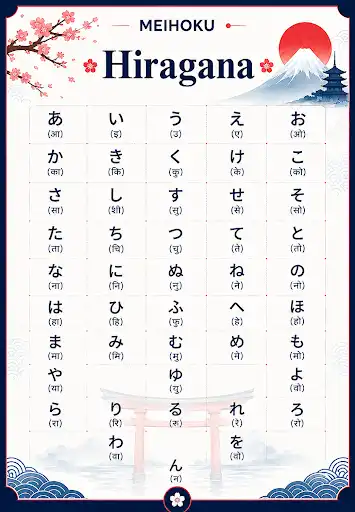
How to read Hiragana chart:
- Read across each row to notice the vowel pattern: a, i, u, e, o.
- Practise the irregular sounds early, especially し (shi), ち (chi), つ (tsu), and ふ (fu).
- Combine characters into real words instead of reciting the chart only from memory.
2. Katakana: The Script for Foreign Words and Emphasis
Katakana is a second phonetic syllabary that represents the exact same set of sounds as Hiragana, but with visually distinct, angular characters. Where Hiragana feels rounded and flowing, Katakana has a sharp, geometric appearance, making it easy to distinguish from Hiragana at a glance.
Katakana’s main function is writing loanwords and foreign-origin vocabulary that has entered Japanese from English, French, German, and other languages. Common examples include:
- コーヒー (koohii): coffee
- テレビ (terebi): television
- インターネット (intaanetto): internet
Beyond loanwords, Katakana also writes foreign names and places (アメリカ, Amerika, “America”), onomatopoeia in manga and casual writing, and scientific or technical terms such as plant and animal species names. Writers also use Katakana to add emphasis or make a word stand out, similar to how English uses italics or bold text.
Complete Katakana Chart
Vowel | K | S | T | N | H | M | Y | R | W |
ア a | カ ka | サ sa | タ ta | ナ na | ハ ha | マ ma | ヤ ya | ラ ra | ワ wa |
イ i | キ ki | シ shi | チ chi | ニ ni | ヒ hi | ミ mi | — | リ ri | — |
ウ u | ク ku | ス su | ツ tsu | ヌ nu | フ fu | ム mu | — | ル ru | — |
エ e | ケ ke | セ se | テ te | ネ ne | ヘ he | メ me | — | レ re | — |
オ o | コ ko | ソ so | ト to | ノ no | ホ ho | モ mo | ヨ yo | ロ ro | ヲ wo* |
ガ ga | ザ za | ダ da | バ ba | ||||||
パ pa |
*ヲ is rare in everyday modern writing. Katakana also uses a long-vowel mark ー, as in ケーキ (kēki, cake).
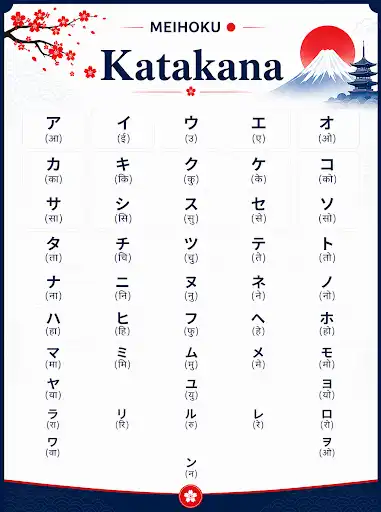
When reading Katakana, look for long vowels, small characters, and consonant changes. For example, ティ (ti) and ファ (fa) are combinations created to represent sounds found in newer loanwords. Do not assume that an English word will keep its original spelling or rhythm after transliteration.
3. Kanji: The Meaning-Based Characters
Kanji are meaning-based Japanese characters historically adopted from Chinese writing. They make vocabulary compact and help readers identify words in text written without spaces.
Kanji concept | Meaning or role | Example |
Character meaning | A symbol contributes meaning | 山 = mountain; 水 = water |
On’yomi | Reading influenced by Chinese pronunciation | さん in 火山 (kazan, volcano) |
Kun’yomi | Native Japanese reading | やま (yama) for 山 |
Compound word | Two or more Kanji combine meaning | 電 + 車 = 電車 (densha, train) |
A character may have several readings, so learn Kanji through common words rather than in isolation. Include the meaning, pronunciation, stroke order, and an example sentence in each study card.
You do not need every Kanji to start reading. Learn basic Kanji alongside both kana scripts, then expand through graded reading as you progress from JLPT N5 toward JLPT N3. The official JLPT description says N5 reading includes typical expressions and sentences written in Hiragana, Katakana, and basic Kanji. That is a more practical target than trying to memorize thousands of symbols at once. Learners can also review basic Japanese words that use these characters in everyday vocabulary.
How Hiragana, Katakana and Kanji Work Together
Japanese writing is a division of labor. Consider this sentence:
私はネパールで日本語を勉強します。
Watashi wa Nepāru de Nihongo o benkyō shimasu.
“I study Japanese in Nepal.”
Text | Script | Function |
私, 日本語, 勉強 | Kanji | Main vocabulary and meaning |
ネパール | Katakana | Foreign place name |
は, で, を, します | Hiragana | Particles and grammatical ending |
This combination helps readers identify word boundaries, grammar, pronunciation, and meaning. Furigana can clarify a difficult Kanji reading, while Romaji may support a complete beginner. Move toward kana and Kanji as soon as possible because Romaji hides important spelling distinctions.
Which Japanese Writing System Should You Learn First
Start with Hiragana, then learn Katakana, and begin basic Kanji as soon as you can read short kana words. This order gives you pronunciation and grammar first while preventing long-term dependence on Romaji.
Learning goal | First priority | Why |
Absolute beginner | Hiragana | It unlocks pronunciation, particles, and native word endings. |
Travel or food reading | Hiragana, then Katakana | Menus, signs, brands, and loanwords often use both kana scripts. |
JLPT N5, JLPT N4 or JFT-Basic preparation | Hiragana + Katakana + basic Kanji | Beginner exams require reading simple written Japanese, including kana and Kanji. |
Work, study, manga, or books | All three together | Kanji is essential for vocabulary density and natural Japanese text. |
Skipping ahead to Kanji before mastering Hiragana is one of the most common mistakes among self-taught learners and those who are preparing for Japan-bound work and study programs such as the Technical Intern Training Program (TITP) through JLPT N5 or JFT-Basic.
Tips to remember Japanese Characters
Use this short routine to connect visual recall, sound, handwriting, and reading. These techniques are also useful when applying broader strategies for learning Japanese effectively
- Practice by writing, not just reading. Stroke order builds muscle memory that passive recognition doesn’t.
- Use mnemonic associations. Many learners link a character’s shape to an image — か (ka) resembling a bent knee, for instance, to speed up recall.
- Drill in short, daily sessions. 10–15 minutes of consistent practice outperforms occasional long study sessions for character retention.
- Read real material early. Children’s books, furigana-supported manga, or beginner graded readers reinforce characters in context rather than isolation, which becomes increasingly important when preparing for JLPT N3.
- Test yourself with flashcards using spaced repetition. Apps that resurface characters right before you’re likely to forget them are proven to accelerate long-term memory.
- Group Kanji by radical. Many Kanji share common components (radicals) that hint at meaning or pronunciation — learning radicals first makes new Kanji easier to guess.
Practice principle: The Japan Foundation’s HIRAGANA / KATAKANA Memory Hint and KANJI Memory Hint resources use mnemonic pictures, quizzes, and games. Use them as supplements, then reinforce each character through real vocabulary, grammar, reading, and handwriting while avoiding common JLPT mistakes during exam preparation.
Ready to excel at Japanese Writing Systems
Understanding the theory behind Hiragana, Katakana, and Kanji is the first step consistent practice is what turns that understanding into real reading and writing ability. Start with the Hiragana chart above, practice a few characters daily, and move to Katakana once recognition feels automatic. From there, JLPT N5-level Kanji will build naturally on the grammar and vocabulary you’ve already learned, providing a foundation for preparing for JLPT N4.
If you are looking for a structured way to continue learning Japanese, Meihoku Training offers training to support learners at different stages. As a best Japanese language institute in Kathmandu, Meihoku provides Japanese language training for learners preparing for study, work, and Japanese language proficiency exams.
Frequently Asked Questions
1. Does Japanese Have an Alphabet?
In Japanese language there is no one alphabet which corresponds to the A–Z alphabet of English. Instead of one alphabet there are several writing systems such as Hiragana and Katakana scripts along with Kanji. Romaji is another way to write Japanese using Latin alphabet which helps in pronouncing the words and phrases temporarily.
2. How Many Japanese Characters Do You Need to Learn?
There is no particular number to learn. Learn 46 basic characters of Hiragana and Katakana script. Next learn common Kanji characters through vocabulary. In case you are preparing for JLPT N5, try not to rely on one universal list of Kanji as unofficial lists are available. Moreover the JLPT does not have a fixed vocabulary list.
3. How Long Does It Take to Learn Hiragana and Katakana?
It depends on how much time you can spend for learning Hiragana and Katakana, your capacity to memorize things and whether you are practicing reading and writing these characters or not. The most important thing that should be kept in mind is that you should memorize the characters in words and not just in an isolated Hiragana Katakana Kanji chart. Ten focused minutes every day is more effective than one long weekly session.
4. Are Hiragana and Katakana the Same?
The characters in both Hiragana and Katakana are same but still both are different scripts having different usages. Hiragana is used to write native words and grammar while Katakana is used to write foreign words, names, technical words etc. They are related kana syllabaries, not interchangeable fonts.
Start Your Journey Today
Admission for the 2025 intake is now open. Seats are limited. Contact us to schedule a free counseling session.
MEIHOKU TRAINING PVT. LTD.

Call Us
+977 9802325688, 01-4031688

Email Us
meihokunepal@gmail.com

Our Location
Sukedhara-04, Akhanda Marg, Kathmandu, Nepal