


What is the JLPT? Understanding the Japanese Language Proficiency Test
If you’ve been learning Japanese, planning to study in Japan or applying for a Japanese work visa, you must’ve likely heard about the Japanese Language Proficiency Test (JLPT).
This internationally recognized exam is a common way to measure your ability to understand Japanese and speak fluently. Institutions such as schools, universities and employers use the results of the JLPT when deciding whether or not to hire or accept you.
This guide will walk you through the JLPT, its 5 levels, what the exam evaluates, how to prepare for it and the opportunities it presents.
What is the Japanese Language Proficiency Test (JLPT)?
The Japanese Language Proficiency Test (JLPT) is a standardized test used to evaluate the Japanese proficiency of non-native speakers and certify their abilities in the Japanese language. The JLPT consists of testing vocabulary, grammar, reading comprehension and listening comprehension.
A passing grade on this exam indicates a good level of proficiency and gives the student an important credential for application to colleges, finding employment and obtaining visas.

JLPT Levels Explained (N5 to N1)
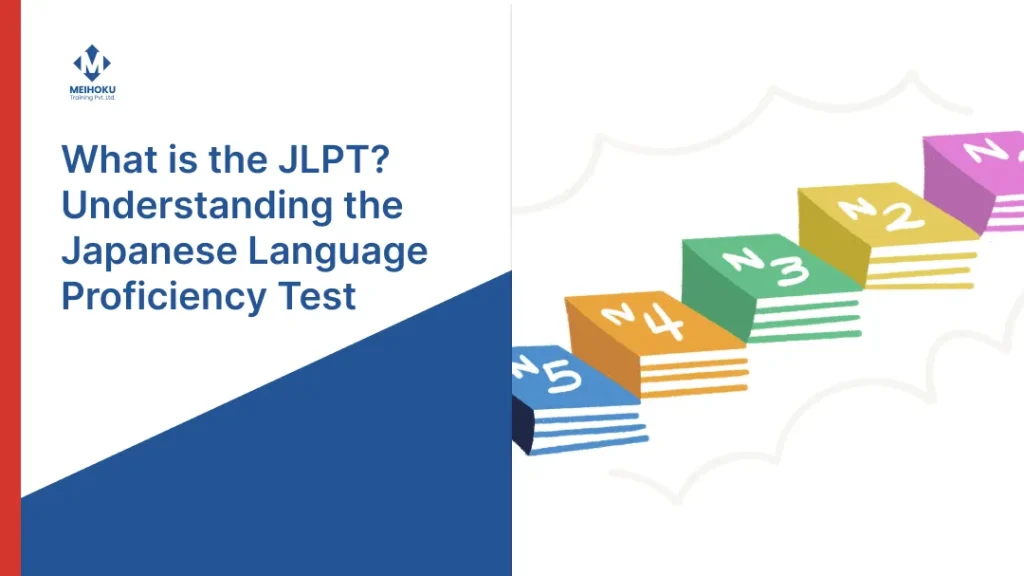
The JLPT has five levels, ranging from beginner (N5) to advanced (N1). With the help of this structured approach, learners can begin with basic proficiency and work their way up to more advanced levels as their skills improve.
JLPT N5 - Beginner Level
Level N5 is the starting level of the JLPT and is for new learners who are just starting to learn Japanese. This level focuses on simple everyday words, basic vocabulary and simple sentences.
- Understand basic Japanese phrases used in daily situations
- Read simple sentences written in hiragana, katakana and basic kanji
- Follow slow and short conversations about familiar topics
JLPT N4 - Elementary Level
Level N4 represents an elementary understanding of Japanese and builds on the basics learned at N5. Learners start understanding slightly more complex sentences and conversations.
- Understand everyday conversations spoken at a slower pace
- Read simple passages related to daily life
- Recognize a larger set of vocabulary and kanji
JLPT N3 - Intermediate Level
Level N3 is considered to be the intermediate level and provides students with the ability to communicate comfortably in Japanese while serving as the bridge between the beginner and advanced levels.
- Understand everyday Japanese used in common situations
- Read simple articles, notices and short written materials
- Follow conversations spoken at near-natural speed
JLPT N2 - Upper Intermediate Level
Level N2 indicates a high level of Japanese proficiency and is often required for professional environments or higher education in Japan.
- Understand newspapers, reports and more complex written texts
- Follow discussions and conversations spoken at natural speed
- Comprehend a wide range of vocabulary and grammar patterns
JLPT N1 - Advanced Level
Level N1 represents the most advanced level of Japanese proficiency based on the use of Japanese and student’s ability to demonstrate their proficiency in using the language.
- Understand complex written materials such as academic texts and editorials
- Follow detailed conversations and lectures in Japanese
- Comprehend nuanced expressions used in professional and formal settings
What Does the JLPT Exam Test?
The JLPT exam measures your knowledge of Japanese in terms of vocabulary, grammar, written language and spoken language in three basic domains: language knowledge, reading comprehension and listening comprehension.
Language Knowledge
This section assesses the basic components of the Japanese language: vocabulary, grammar and kanji knowledge. It evaluates your ability to identify and appropriately use Japanese vocabulary and sentence structure.
- Vocabulary: The ability to understand Japanese words in a variety of settings.
- Grammar: Knowledge of how to use Japanese sentence structure.
- Kanji Recognition: The ability to read and understand written Japanese characters.
- Word Usage: The ability to select the correct Japanese word/phrase depending upon the context in which it is being used.
Reading Comprehension
The reading section assesses your ability regarding how well you comprehend written Japanese text across various types of texts. As you increase your level in JLPT proficiency, the level and length of the passage also increases.
- Understand the difference in short and long written passages.
- Read original content such as essays, articles, stories and notices.
- Identify the main context and supporting details in texts.
- Interpret the speaker’s intentions and the context in which they’re writing.
- Read Japanese texts accurately.
Listening Comprehension
In this section, you will be assessed on your ability to understand spoken Japanese in everyday situations such as conversations. Recordings of each question will be played once before you answer them based on what you hear.
- Understand conversation between speakers.
- Follow instructions, announcements and short presentations.
- Identity key contexts and the overall meaning of conversations.
- Process spoken Japanese delivered to you at a natural speed.
JLPT in Nepal: Examination Dates, Centres and Registration Details
Since education and employment in Japan is appealing for many Nepali workers and students, the Japanese Language Proficiency Test (JLPT) draws thousands of applicants each year. The test is officially conducted by the Japanese Language Teachers’ Association (JALTAN) in cooperation with the Embassy of Japan in Nepal.
Examination Dates
The JLPT examination is held twice a year in Nepal: July and December.
- July Session: First Sunday of July
- December Session: First Sunday of December
- Levels Offered: All five levels (N5, N4, N3, N2, N1)
- Result Announcement: For the July examination – around late August or early September and for the December examination – late January or early February
Registration Process
Candidates must complete their registration during the official application period before the exam.
- Step 1: Self-assess your Japanese proficiency and select the level of JLPT you wish to take (N5-N1).
- Step 2: Register your account and fill out the online application form via the local host institution’s website or the official JLPT website.
- Step 3: Upload the required documents and photographs as stated in the form and select your preferred test centre location.
- Step 4: Pay your examination fee and confirm your registration.
- Step 5: Download and print your test voucher as it is required on your examination day.
- Step 6: Bring along the original Test Admission Ticket which will be mailed to your registered address 1-2 weeks before the exam to your test centre.
Test Centres
The JLPT is mainly conducted in Kathmandu, where selected educational institutions serve as official test venues. Past examinations have been held at schools such as:
- St. Mary’s School, Jawalakhel
- D.A.V. School, Jawalakhel
Test centres may vary each year depending on the number of applicants and the organizing institutions.

How to Prepare for the JLPT Exam
Since the exam evaluates vocabulary, grammar, reading and listening skills, learners should focus on strengthening each of these areas through regular study and practical exercises.
- Develop Your Vocabulary and Kanji: Build familiarity with commonly used Japanese words and kanji that appear frequently in JLPT exams.
- Practice Grammar Patterns: Study the structure of Japanese sentences, particles and all relevant grammar items in terms of your JLPT level.
- Improve Reading Skills: Develop your reading ability by practicing reading through short paragraphs, articles and other sample texts.
- Strengthen Listening Skills: Develop your listening ability through listening to conversations and announcements, as well as listening to audio resources.
- Take Practice Tests: Take practice tests (mock exams or previous JLPT test questions) to familiarize yourself with the format of the test and improve your speed in completing it.
For many learners, preparing with a structured curriculum and experienced instructors can make the process more effective, as it provides clear guidance, consistent practice and expert feedback that can be difficult to achieve through self-study alone.
Why Choose Meihoku Training’s Language Courses
For learners who want structured preparation and expert guidance, Meihoku Training offers Japanese language courses (N5-N3) designed to help students build a strong foundation and prepare confidently for the JLPT.
- Complete JLPT-Focused Curriculum: Classes are aligned with the official JLPT structure, from N5 to N3, helping students prepare strategically for each level.
- Practical Communication Skills: Real life communication is prioritized so students can use Japanese confidently in work, study and daily life.
- Experienced Native and Nepali Instructors: Combination of native Japanese teachers with Nepali facilitators to bridge language understanding effectively.
- Exam Preparation and Mock Tests: Regular mock exams, revision sessions and proven test strategies significantly improve student success rate.
How JLPT Opens Doors to Study and Work Opportunities
Many Nepali learners wishing to work or study in Japan use the Japanese Language Proficiency Test (JLPT) to improve their chances of gaining educational, vocational and professional opportunities.
Study Opportunities
Japanese universities, language schools and vocational institutions require evidence of language ability from all international students who wish to enroll in their programs. For individuals who wish to study in Japan, the JLPT is one of the most widely recognized ways to prove language proficiency.
In many cases, achieving JLPT levels N2 or N1 provides the best indication that a student is able to learn in Japanese medium environments.
Employment Opportunities
The JLPT serves as a language eligibility requirement for employment in Japan, facilitating access to job opportunities with companies closely allied to Japanese businesses. Many employers use JLPT results as a benchmark when evaluating the Japanese language ability of international applicants.
For many Nepali workers, Japanese language proficiency is also important when applying for programs such as the Technical Intern Training Program (TITP) and the Specified Skilled Worker (SSW) program, both of which require the ability to understand workplace instructions and communicate effectively in Japanese.
Most companies in Japan give preference to applicants who hold a level of JLPT of N2 or higher, as it indicates the ability to communicate with colleagues in professional environments, understand workplace discussions and read business related documents.
Internationally Recognized Certification
The largest single benefit of holding a JLPT certification is that the JLPT is recognized globally. Therefore, the JLPT is accepted by all major universities, companies and governments as proof of proficiency in the Japanese language.
Conclusion
Whether your goal is to study in Japan, gain employment in Japanese companies or just strengthen your Japanese language proficiency, obtaining a JLPT certification opens up many valuable opportunities. Alongside measuring your Japanese proficiency, this exam serves as an internationally recognized certificate that supports your academic and professional goals.
Having the right guidance and structured training in your preparation for the JLPT examination can make a significant difference. At Meihoku Training, students can receive Japanese language courses from level N5 to N3 to prepare for the JLPT exam and improve their proficiency level.
Frequently Asked Questions
1. How long do JLPT results take to get published?
JLPT results are published approximately two months after the test date. A notification of pass/fail is delivered to the test taker after approximately three months.
2. How do I check my JLPT results online?
To check for your JLPT results online, visit the official JLPT website or local host site and login to the site using your registration number and passcode from the test voucher.Click on the “Test Results and Certificate Issuance” to view your results.
3. What are the levels of the JLPT examination?
There are 5 levels of JLPT based on the level of difficulty and proficiency:
- N5 – Beginner Level
- N4 – Elementary Level
- N3 – Intermediate Level
- N2 – Upper Intermediate Level
- N1 – Advanced Level
4. What is the passing score of the JLPT examination?
Depending on your level of JLPT examination, the passing scores differ:
- N5 – 80 points
- N4 – 90 points
- N3 – 95 points
- N2 – 90 points
- N1 – 100 points
5. Do we require JLPT certification to study in Japan?
Yes, most Japanese universities ask for JLPT certification of N2 or N1 to certify your proficiency in the Japanese language.
6. What is the JLPT exam fee in Nepal?
JLPT registration fee in Nepal is around NPR. 2,000 – 3,000 depending on your level of examination.
7. What does the JLPT exam test?
The JLPT exam tests your knowledge of Japanese with regards to three sections:
- Language Knowledge
- Reading Comprehension
- Listening Comprehension
8. When is the JLPT examination held in Nepal?
In Nepal, the JLPT examination is held twice a year: July and December.
Start Your Journey Today
Admission for the 2025 intake is now open. Seats are limited. Contact us to schedule a free counseling session.
MEIHOKU TRAINING PVT. LTD.

Call Us
+977 9802325688, 01-4031688

Email Us
meihokunepal@gmail.com

Our Location
Sukedhara-04, Akhanda Marg, Kathmandu, Nepal